
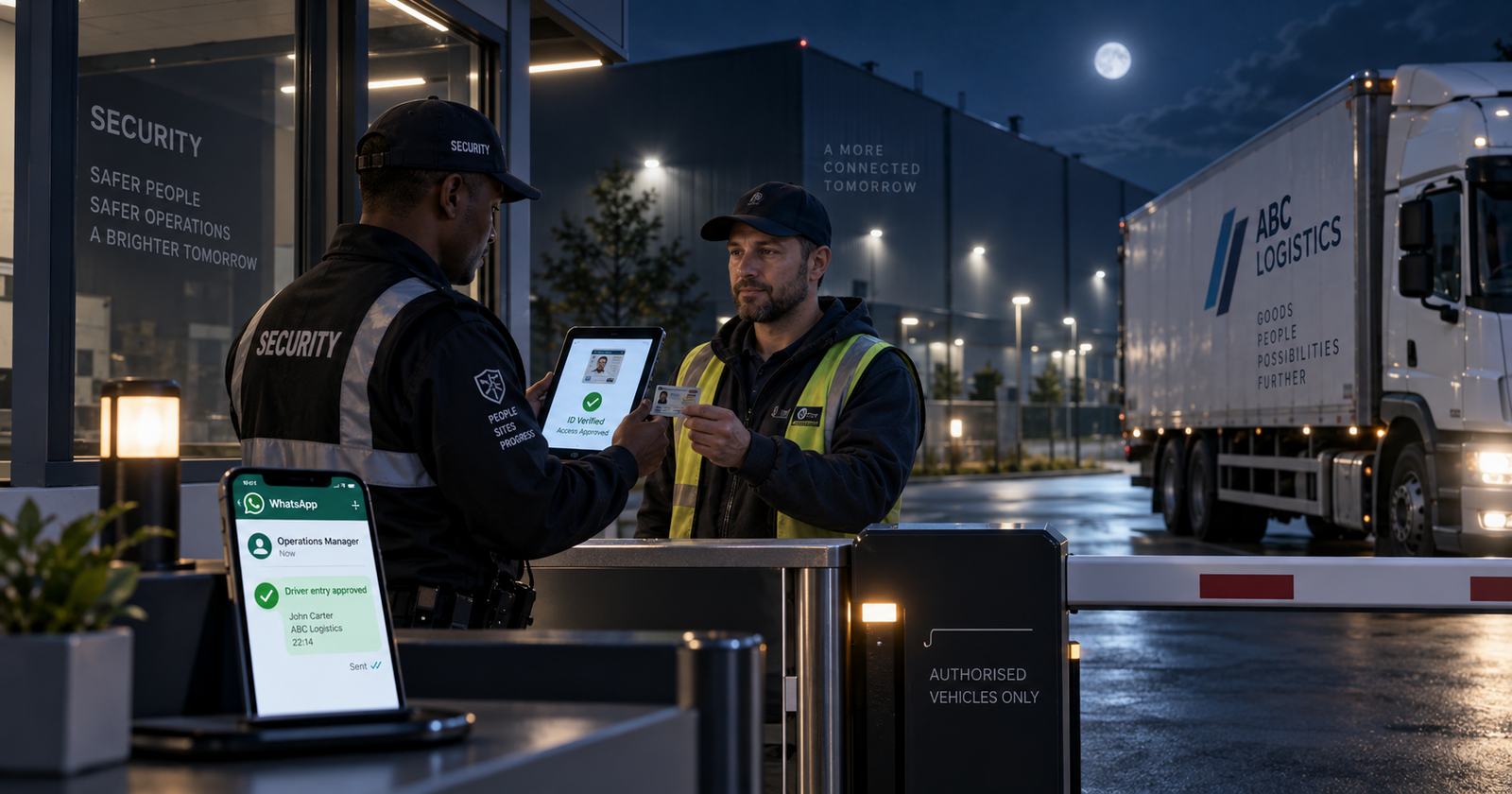
When staff or contractors need access to a facility outside normal business hours, having a clear night-shift gate entry approval process matters more than ever. At 2 am, the usual chain of command may be asleep, off-site, or simply unreachable, which means the decision of who can authorize entry must be established well in advance. Without a defined night-shift gate entry approval protocol, security personnel are left guessing, delays pile up, and unauthorized access becomes more likely. Facilities that plan ahead designate specific roles, backup contacts, and verification steps so that even in the middle of the night, entry approval remains consistent, accountable, and secure.
At 2 am, a transporter's truck idles at the gate with a delivery that was supposed to arrive at 6 pm. The security guard on duty has no idea who ordered it, whether it should be accepted tonight or held till morning, and the one person who might know — a shift supervisor — is not answering the landline. This is not a hypothetical. Night shifts, especially in factories and warehouses running two or three shifts, produce a steady stream of exactly this kind of ambiguity: a contractor's replacement worker showing up unannounced, a staff member who forgot something in the office, a courier trying to beat a morning deadline. Establishing a documented night-shift gate entry approval chain prevents the exact 2 am scenario where a delivery truck idles while the guard has no one to call. Facilities running multiple shifts often find that their night-shift gate entry approval breaks down precisely when a contractor's replacement worker shows up unannounced and no verification record exists for them. A reliable night-shift gate entry approval system assigns backup contacts so that an unanswered landline doesn't leave a security guard stranded with an idling truck. Unlike daytime access, where supervisors and institutional memory fill gaps, night-shift gate entry approval must function as a standalone protocol that doesn't rely on someone being awake to make a judgment call. Indian factories and campuses that formalize night-shift gate entry approval reduce the one-minute decision pressure guards face when a courier tries to beat a morning deadline with no one available to confirm the order. A well-structured night-shift gate entry approval process should specify exactly which documents—work order, ID proof, or dispatch note—a security guard must verify before waving a vehicle through after hours.
The daytime version of this problem is manageable because there are more people around to ask, more supervisors on the floor, and enough institutional memory to make a judgment call. At night, the gate is often staffed by one or two guards who are not authorised — and should not be authorised — to decide who gets in. The question "who approves at 2 am" is really a question about whether your access process depends on someone being awake and present, or whether it works the same way at 2 am as it does at 2 pm.
This article examines the specific failure points of after-hours entry in Indian offices, factories, and campuses. It also explores what a workable night-shift approval process actually requires. This isn't about theory, but about real field conditions. In these situations, a guard stands in front of a vehicle. That guard needs an answer in under a minute.
Why night shifts break normal gate discipline
Most gate processes are designed around the assumption that a host, HR person or supervisor is on-site and reachable. That assumption holds for most of the working day. It collapses after 9 or 10 pm for several reasons.
Fewer people, less authority at the gate
A day shift might have a receptionist, an admin executive and a security supervisor all capable of making a call on an unexpected visitor. A night shift typically has security staff only, and their job description does not include deciding whether a visitor's stated purpose is legitimate. Left without a clear escalation path, guards either turn people away who should have been let in, or wave through people who should have been stopped — both are compliance and safety problems. When facilities operate three shifts, night-shift gate entry approval typically requires a rotating on-call list so that at least one authorized person is reachable at any hour, not just during the day shift.
Contractors and transporters do not stop working at sunset
Warehouses receiving inbound stock, factories running production shifts, and campuses with round-the-clock housekeeping or maintenance contracts all have legitimate reasons for after-hours movement. A transporter delivering raw material for the morning shift, a contractor's electrician called in for a breakdown, or a housekeeping crew starting at 11 pm are routine, not exceptional. The gate needs a process that treats these as normal traffic, not as incidents requiring a phone call up the chain.
Escalation by phone does not scale
The traditional answer — "call the manager" — depends on a manager who is reachable, awake and willing to authorise something over a voice call with no record left behind. In practice, calls go unanswered, numbers change, and even when someone does pick up, there is no trail showing who said yes and on what basis. If an incident happens after such a verbal approval, the register shows nothing.
What a night-shift entry actually needs
An after-hours entry process must satisfy three things, just like a daytime process does. It must verify identity, get accountable approval, and leave a record. It must do all this without requiring a person to be physically present.
Identity capture that does not depend on staff literacy or attention
At 2 am, a tired guard is not going to painstakingly copy an ID number into a paper register, and if he does, the handwriting is often unreadable by morning. A gate that captures a photo and reads the ID document automatically removes this dependency entirely — the guard's job becomes pointing a tablet at a driving licence or Aadhaar card, not transcribing it. For a fuller picture of what a modern gate needs to record, see our guide on gate pass management software. Digital logging tied to night-shift gate entry approval allows management to review the next morning exactly who authorized a late-night entry, closing the accountability gap that phone-based verbal approvals often leave open.
An approval that reaches a real person, wherever they are
The core problem at 2 am is not identity — it's authorisation. A guard cannot decide, on his own judgment, whether a night delivery should be accepted. What he needs is a way to put the decision in front of the person who can actually make it, in a channel that person will see and respond to even when they're not at their desk. This is precisely where VizPass routes the request as a WhatsApp approval to the host — a message the host can act on from home, in bed, or on the way somewhere, with a single tap. It doesn't require a landline, a login, or someone standing by a gate computer.
A pass and a record, not a verbal yes
A phone call that ends in "haan bhej do" (yes, send him) leaves nothing behind. A workable process needs the approval to generate something physical and something logged — a printed pass the visitor carries, and an entry in the register that shows who approved it and when. That single QR-coded pass, printed in whatever format suits the gate — A6, A7, a badge or a thermal label — becomes the visitor's authority to be on site, and scanning it at the out-gate closes the record cleanly.
Handling the specific cases that show up after dark
Night traffic is not random. It falls into a small number of recurring categories, each of which needs slightly different handling.
Delayed or early transporters
A truck arriving outside its scheduled window still needs the same material gate pass discipline as a daytime delivery — items, quantity and vehicle number recorded, and outward movement (if the vehicle is also carrying something out) approved before it leaves. Our page on material gate pass handling covers how inward and outward, returnable and non-returnable movements should be logged regardless of the hour. Some campuses integrate biometric or OTP-based verification into their night-shift gate entry approval workflow so that a sleeping supervisor's unavailability no longer stalls a legitimate delivery at the gate.
Contractors called in for breakdowns
An electrician or technician called in outside normal hours for an emergency repair is still a contractor, and still needs their induction and validity checked at the gate — a night emergency is not a reason to skip this, since an expired induction is exactly the kind of gap that causes an incident during unsupervised night work. Details on how this should work are on our contractor and labour entry page.
Staff who need to step out or return late
A staff out-pass — someone leaving mid-shift and returning, or returning to collect something after hours — still needs a manager's approval and should be stamped both out and in, exactly as it would during the day. The absence of a manager physically present at night is not a reason to skip the stamp; it's a reason to make sure the approval channel works from wherever the manager actually is.
Couriers arriving off-schedule
Courier deliveries sometimes arrive at odd hours. This is common with e-commerce logistics and 24-hour warehouses. These deliveries still need to be logged as couriers. They should not be waved through as general visitors. This ensures the record shows what arrived. It also shows who the delivery was for. Finally, it shows when the item was collected.
Overstays and the morning-after problem
Night-shift gates face a particular version of the overstay problem. A visitor or contractor enters at 10 pm. They remain on-site at 6 am, past the shift change. No one is quite sure if they left through a different gate. They might still be somewhere on the premises. The on-site list comes from open records. Anyone without a closed exit is still "in." An overstay becomes visible immediately, not discovered hours later. The host can be chased before the situation compounds across a shift handover. This matters more at night than during the day. Fewer people are around to notice someone who shouldn't be there. Without escalation timers built into night-shift gate entry approval, a guard may wait indefinitely for a callback instead of following a pre-set rule for holding or rejecting entry after a fixed number of minutes.
Mistakes happen — the record has to survive them
A guard half-asleep at 3 am will occasionally log the wrong vehicle number, tap the wrong approval, or double-enter a name. The right response is not to delete the entry and hope no one asks — a deleted record is indistinguishable from a cover-up if it's ever reviewed. A mistaken entry should be reversed with a reason attached, so the log shows what happened and why it was corrected, keeping the register honest even when the shift wasn't.
Compliance does not take the night off
The Factories Act 1948 and state Factories Rules govern contractor engagement on your premises. The Contract Labour (Regulation and Abolition) Act 1970 also applies to these workers. These rules cover workers at all hours, day or night. DGFASLI safety expectations for factory premises follow the same logic. An incident during a night shift gets scrutinised just like one during the day. A gate register that goes silent after 9 pm signals a visible gap in an audit. This happens when no one bothers to log entries during those hours. Personal data captured at the gate also needs consistent handling. This includes photographs and ID details collected from workers. Such data should follow guidance from the Ministry of Electronics & IT. This applies whether the data was captured at noon or at 2 am.
Getting the roles right for a night shift
Part of what makes after-hours entry manageable is making sure the guard on duty has exactly the access they need and nothing they're not equipped to handle. A Security Guard role in VizPass sees only the gate — enough to process entries, print passes and scan exits, without being handed decisions about who to approve. Approval sits with the host, not the person standing at the barrier, which is precisely the separation that makes a 2 am delivery workable without waking up half the company on the phone.
Conclusion
After-hours entry fails when it depends on a person being awake and reachable by phone. It needs to work the same at 2 am as at 2 pm. A guard should process any visitor with a tablet. A host should approve entry from a phone in bed. A register should log the decision instead of losing it to a verbal yes. Many night shifts still run on landline calls and a guard's best guess. It's worth checking how your gate would handle a delayed transporter tonight. Or an emergency contractor call-out tonight. You can see how this works end to end on our how it works page. Or book a walkthrough at /contact. VizPass runs on a 7-day trial at ₹4,999/month. We operate from our office in Sector 62, Noida. It's designed to make the 2 am gate as accountable as the 2 pm one.