
Gate Pass Management System for Indian Workplaces
VizPass gate pass management software unifies visitor, material, courier, and out-gate passes into one register with tablet-based issuance, WhatsApp approvals, and QR-based gate closure, built for how Indian plants and offices actually operate. Every entry stays auditable, overstays get flagged, and mistakes are corrected—never deleted—so the register remains a reliable single source of truth.
A visitor walks in, a supplier's truck waits at the boom barrier, a contractor's helper wants to step out for lunch, and a courier boy is holding a parcel for the stores department — all at the same gate, often within the same ten minutes. Most plants handle this with three different registers, a watchman's memory, and a phone call to the department if anyone remembers to make one. A gate pass management system replaces that with one register and one workflow, built for how an Indian shop floor actually runs.
What Is a Gate Pass Management System?
A gate pass management system is an electronic gate pass register: it records every pass issued at a site's gate — visitors, material going in and out, couriers, and staff stepping out during a shift — together with who approved it and when it was closed. It replaces the paper gate pass book and the guard's memory with one searchable record per gate.
One Register, Four Kinds of Pass
A plant gate doesn't only deal with visitors. It deals with material coming in, material going out, couriers dropping parcels, and staff or contract labour stepping out for a smoke, a bank visit, or a shift change. Trying to track all four on separate paper books is why registers go missing, entries get backdated, and nobody can answer "who let this out" three days later.
VizPass keeps all four on one register:
- Visitor pass — for anyone visiting from outside the company
- Material gate pass — inward and outward, for anything moving through the gate
- Courier/parcel pass — for delivery staff dropping or collecting items
- Out-gate pass — for employees, or contract staff on your people list, stepping out during working hours
One system also means one audit trail, with each kind of pass searchable and exported as CSV from its own list — instead of four books in four different states of completeness.
How a Visitor Pass Actually Gets Issued
At the gate, a tablet does the work a security guard used to do by hand. The visitor's photo is captured, their ID is photographed and the number and name are read into the form for the guard to check instead of copied out by pen, and the host gets an approval request on WhatsApp rather than a phone call that may or may not go through. Once approved, the pass prints — and the print size itself is configurable per company, so a large campus with multiple entry points can standardise on whatever card size their existing pass holders and printers already use.
Every printed pass carries a QR code. When the visitor leaves, the out-gate scans that QR to close the record — no separate exit register, no guard trying to remember who's still inside. This single detail solves a problem every plant head has run into: knowing, at any given moment, exactly who is on premises and who has already left.
Material Passes: A Gate Record, Not an Inventory System
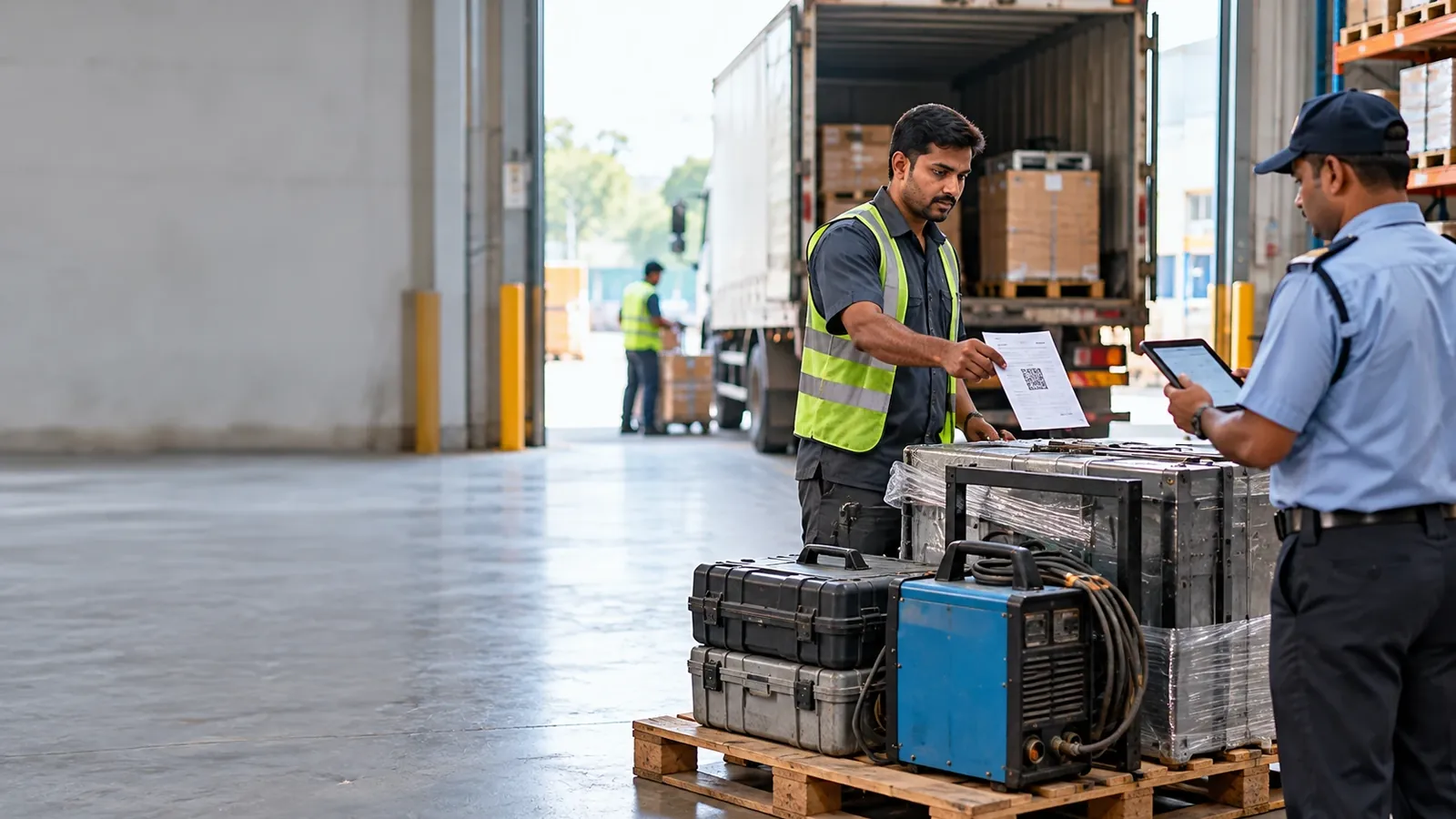
Material passes are where gate registers usually break down under real load — a 40-machine unit with three shifts and a dozen vendors moving spares, tools, and finished goods through the same gate every day generates far more material movement than visitor traffic.
A material pass on VizPass names:
- The items and quantity
- The vehicle number
- The person carrying the material
For outward material, the gate does not release anything without an approval on record first — this is deliberate, because outward movement is where pilferage and disputes happen, and a recorded approval before the exit is worth more than a reconciliation done a week later.
It's worth being precise about what this is and isn't. VizPass does not do weighbridge integration, and it does not post entries into your ERP. A material gate pass here is a gate record — proof of what left or entered, when, in whose custody, and under whose approval. If your stores team needs that movement to update stock ledgers, that's a separate step your ERP handles; VizPass isn't trying to be your inventory system, and pretending otherwise would only cause confusion at audit time. What it does give you is a clean, timestamped, tamper-evident account of gate activity that your ERP data can be checked against.
Approvals That Don't Depend on Someone Being at Their Desk
Every plant has an approval chain on paper — security clearance, then department head, then maybe safety for hazardous material — and every plant has watched that chain stall because the approver was in a meeting, on the floor, or simply didn't see the message. For material passes, VizPass lets you define that chain the way your company actually works, and if an approval sits unanswered for 24 hours, it escalates automatically to the next level, with the Security Head and Company Admin alerted, rather than sitting there indefinitely. Visitor approvals go to the host and do not escalate.
This matters more in Indian plants than the software vendors admit, because contract labour turnover means approval chains change often, and a truck waiting at the gate during a power cut is not a hypothetical — it's a Tuesday. An escalation path that fires on its own, without someone having to chase it manually, keeps a material pass from stalling for good when the usual approver is unreachable.
Passes Expire, Overstays Get Flagged
A pass isn't a one-time event; it can carry an end time, and an expired pass is refused at entry. If a visitor or contractor is still inside after that end time, the host and Company Admins are alerted once, in the bell and by email, and the visitor stays flagged on the dashboard and the On Site list — instead of relying on a guard noticing three hours later that someone's still wandering the premises. VizPass does not track zones, escorts or restricted areas, so the alert sits alongside, not in place of, the physical safety practices your plant should already be following per DGFASLI guidelines for factory premises.
Corrections, Search, and Who Gets to See What
Gate registers get mistakes — a wrong vehicle number, a name entered under the wrong company. Paper registers get these mistakes crossed out, or worse, torn out. VizPass doesn't delete a mistaken entry; it reverses it with a reason, and the correction stays visible in the record. If an auditor or a client asks why an entry changed, the answer is right there instead of being a source of suspicion.
The full register is searchable by:
- Name
- Phone number
- Company
- Vehicle number
- Date
Reports and exports follow role permissions, so a site security head can pull six months of gate data for an audit, while staff limited to one site see only that site's records. This also matters for how you handle personal data collected at the gate — ID details, photos, phone numbers — which is worth reviewing against the Ministry of Electronics & IT guidance on personal data handling, since a gate register today holds more identifiable information than most people realise.
One Gate or Twenty, Under One Company
Whether you're running a single gate at one facility or several gates across multiple sites under the same company, the register works the same way — one account, consistent pass formats, and a shared view across locations for whoever needs to see the whole company's gate activity rather than just one site's. This is particularly relevant if your operations span a head office, a plant, and a warehouse, each with different footfall patterns but the same need for accountability.
If you're comparing this against what your gate currently does on paper, the honest way to evaluate it is to look at your busiest hour — shift change, a delivery window, a contractor crew arriving together — and ask how long it currently takes to know exactly who is inside, what's moved, and what's pending approval. You can see the complete feature set on /features, check how pricing works for single or multi-site setups on /pricing, or book a walkthrough with your actual gate volumes in mind rather than a generic demo.
What an Automated Gate Pass System Takes Off the Guard's Desk
Expected Visitors Already Listed
Pre-registered visitors are on the gate's list before they arrive.
Pre-registrationApproval Without a Phone Call
The host or approver taps admit or decline on WhatsApp.
WhatsApp approvalExit Closes the Record
A QR scan at the exit closes the pass; an open pass stays visible on the log.
QR exit scanOverstays Flagged
Anyone inside after their pass expires is reported to the host and admins.
Overstay alertMaterial Chased When Overdue
Returnable passes remind before the due date and alert after it.
RGP overdue alertsReports for Any Date Range
Every pass — visitor, material, courier, staff — searchable in its own list, with CSV export.
One registerGate Pass Management System for Indian Workplaces FAQs
Does Gate Pass Software Still Work During Power Cuts, Which Happen Often at Our Plant?
Only while the gate device has a network connection. Check-in needs a connection; if the network drops, the guard keeps a paper log and enters those visits once it is back. Nothing is stored on the gate device to send later, and an entry typed in afterwards carries the time it was entered, not the time the person arrived, so the paper log should note the real times for anyone who later asks "who came in during the outage?" A power cut on its own need not stop the gate: put the tablet, the pass printer and the router on a small UPS, or let the guard work on a phone with mobile data, and the visitor, material, courier and out-gate passes keep running as usual. You can see how this fits into the rest of the system on the features page.
How Do We Track Outward Material Gate Passes so They Can Be Checked Later Against Dispatch Records?
Outward material passes sit in VizPass alongside visitor, courier, and out-gate entries, with their own list and reports so they can be pulled out separately. Each pass records what's leaving — items, quantity and value — the vehicle number and driver, the department, who approved it and when the gate let it out: the same information a paper material register would hold, except searchable. The material reports filter by date range and export as CSV, and a returnable item stays open until its return is logged under its own RTN number. This is one of the specific use cases the software is built around, since material movement is usually the messiest of the four registers to reconcile. For an audit, this means producing one filtered export instead of physically tracking down a register that may or may not have been filled in consistently that week.
Our Security Guards Mostly Read Hindi or the Local Language, Not English — Will They Be Able to Use This at the Gate?
Partly. Staff signed in to VizPass on the web, guards included, can switch their own screens to Hindi or Marathi, so a guard working at the web desk sees the web screens labelled in that language. The VizPass phone app and the forms visitors fill in themselves are in English, so a guard who works only on the phone app needs to follow English labels, and it is worth walking them through those screens once. Whatever language the screen shows, the entry lands in the same record, so admin or HR reviewing it later see one consistent format. This avoids a common failure mode with paper registers, where entries are illegible or inconsistent because different guards write differently across shifts. More on how the gate-side workflow is built is on the features page.
Is the Visitor and Employee Data We Collect at the Gate Handled Safely Under Indian Data Rules?
The system is built to collect only the fields needed for the four gate registers — name, contact, ID reference, purpose, time in/out — rather than open-ended notes scattered across paper books that anyone at the gate can flip through. Centralizing this in one system means access can be limited to authorized admin logins instead of a register sitting on the guard's table, readable by anyone passing the gate. Visitors who register on the gate app or through the self-registration link see your privacy notice and agree to it before their photo and ID are taken, and that agreement is recorded on the pass. VizPass keeps the record; meeting your obligations under the DPDP Act stays with you as the data fiduciary, and MeitY publishes the framework at meity.gov.in for organizations structuring their own policies. From a mechanics standpoint, having one digital register instead of four paper ones also makes it more straightforward to know exactly where visitor and employee data lives, who can pull it up, and how far back the records go — which is harder to answer when the same information is split across a visitor book, a material register, and a courier logbook kept in different drawers.
How Do We Keep Track of Contract Labour Who Step Out Mid-Shift for Lunch or a Bank Visit?
This is what the out-gate pass is for — it's issued to the specific person, records the time they left and the reason, and stays open until they're logged back in. Unlike a visitor or material pass, it's tied to someone already on-site, so it's less about who's allowed in and more about knowing who's currently outside the gate and why. Security at the gate issues it the same way they would any other pass, and the out-gate list shows everyone currently out, so there's one place to check if someone asks "who's currently out" or "who left during the shift." This tends to matter most in factories and warehouses with contract labour on rotating shifts, which is one of the industries this is built for. It works the same for an employee or a contract worker, provided the worker is on your people list as contract or vendor staff — labour checked in only as visitors cannot get one — and the pass is closed out when they return, instead of relying on the watchman remembering who walked out an hour ago. Out-gate passes need the Gate Control plan.
Can We Pull the Kind of Gate Records a Factory Inspector Might Ask to See?
Yes — all four pass types are in VizPass, and each can be filtered and exported as CSV for a date range instead of reconciling separate visitor, material, courier, and out-gate books by hand. Factory inspections often look at material movement and personnel entry/exit alongside safety documentation, and guidance on what factories are expected to maintain is published by DGFASLI at dgfasli.gov.in. The software itself doesn't generate safety compliance — it generates the underlying gate record: who came in, what moved out, who stepped out and when, all timestamped and attributed. That record can then be exported and handed over alongside whatever safety paperwork the inspector is reviewing, rather than someone spending the inspection window flipping through four separate registers to find matching entries. If it's easier to see this against your own gate setup, the contact page has a way to book a walkthrough rather than working it out from a features list alone.
What Is an Electronic Gate Pass System?
An electronic gate pass system replaces paper slips and registers with passes issued on a tablet or phone: the person or material is recorded at the gate, approved by the host or an approver, given a pass with a QR code, and closed with a scan on the way out. VizPass covers visitor, material (returnable and non-returnable), courier and staff out passes in one register.
Can Gate Passes Be Automated?
The paperwork can. Pre-registered visitors are on the gate's list before they arrive, approvals go out on WhatsApp, overstay alerts fire on their own, and overdue returnable material is chased automatically. VizPass does not drive boom barriers or turnstiles — it is the software record behind the gate.
Is There an Online Gate Pass Management System for Material?
Yes. Material goes out on a returnable (RGP) or non-returnable (NRGP) gate pass with item lines, quantity, value and a due date; each return is logged against the pass with its own number, and overdue items trigger alerts.
Rolling It Out Without Stopping the Gate
Any change at the gate meets resistance if it slows the queue on day one, so the switch works best gate by gate, shift by shift, rather than as a single cut-over across a 40-machine unit with three entry points. Guards need the workflow explained in the language they actually use at the gate, not the language of a training manual — and because the approval chain is something the company defines, it's worth mapping who really approves what before the first tablet goes live.
- Start with one gate, run it alongside the paper register for a week, then retire the register
- Train the guard on the exception path first — what happens on a power cut, what happens when a host doesn't respond — not just the happy path
- Fix the pass print size and the approval chain before rollout, not after; changing either mid-way confuses everyone who's just learned the old one
- For multi-site companies, roll out site by site — see /industries — rather than all at once; shift patterns rarely match across plants
Common First-Month Mistakes
Most gate pass rollouts stumble on the same handful of things, and none of them are about the software itself.
- Treating the approval chain as optional and routing everything to one person, who then becomes the exact bottleneck the escalation was meant to prevent
- Setting a validity window too loose to matter — an overstay flag means nothing if the window is "end of day" for a two-hour visit
- Typing a wrong entry again as a fresh visit instead of reversing the first one with a reason; the correction has to stay visible, especially if the visit is questioned later
- Skipping the vehicle number field on a material pass because "everyone knows the transporter" — until the day nobody does
What's Worth Watching Once It's Running
A gate register nobody reviews is just a digital paper book. A few things worth checking periodically, more useful than any vanity metric:
- How often passes escalate past the first approver — a high rate usually means the chain is drawn wrong, not that people are slow
- Whether the same visitor or contractor keeps showing up flagged for overstay — a pattern is worth a conversation, a one-off isn't
- Who's actually pulling exports, and whether that matches who has permission to — this is worth tightening the same way companies are tightening how they handle personal data more generally
For a fuller list of what the system does day to day, /features covers it; for what it costs at your scale, /pricing has the detail, and visitor management software pricing in India sets published vendor prices side by side.
Where a Gate Register Stops
VizPass is a record of who and what crossed the gate — it is not a weighbridge and not an ERP. A material pass names the items, the quantity, the vehicle number and the person carrying, and outward material needs an approval on record before release, but it will not weigh the truck or post a stock entry against a material code. If your process needs the gate event to trigger an inventory movement, that integration has to live downstream, on the ERP side, not at the gate.
Used as what it is — a gate record, not an inventory system — it holds up well on audit, including alongside the safety documentation many plants already maintain for DGFASLI inspections. Trying to make it do more than that is usually where disappointment starts. If you're not sure which side of that line your process falls on, /use-cases walks through how different plants have drawn it.
Further reading
- Chain of custody — Wikipedia
- QR code — Wikipedia