
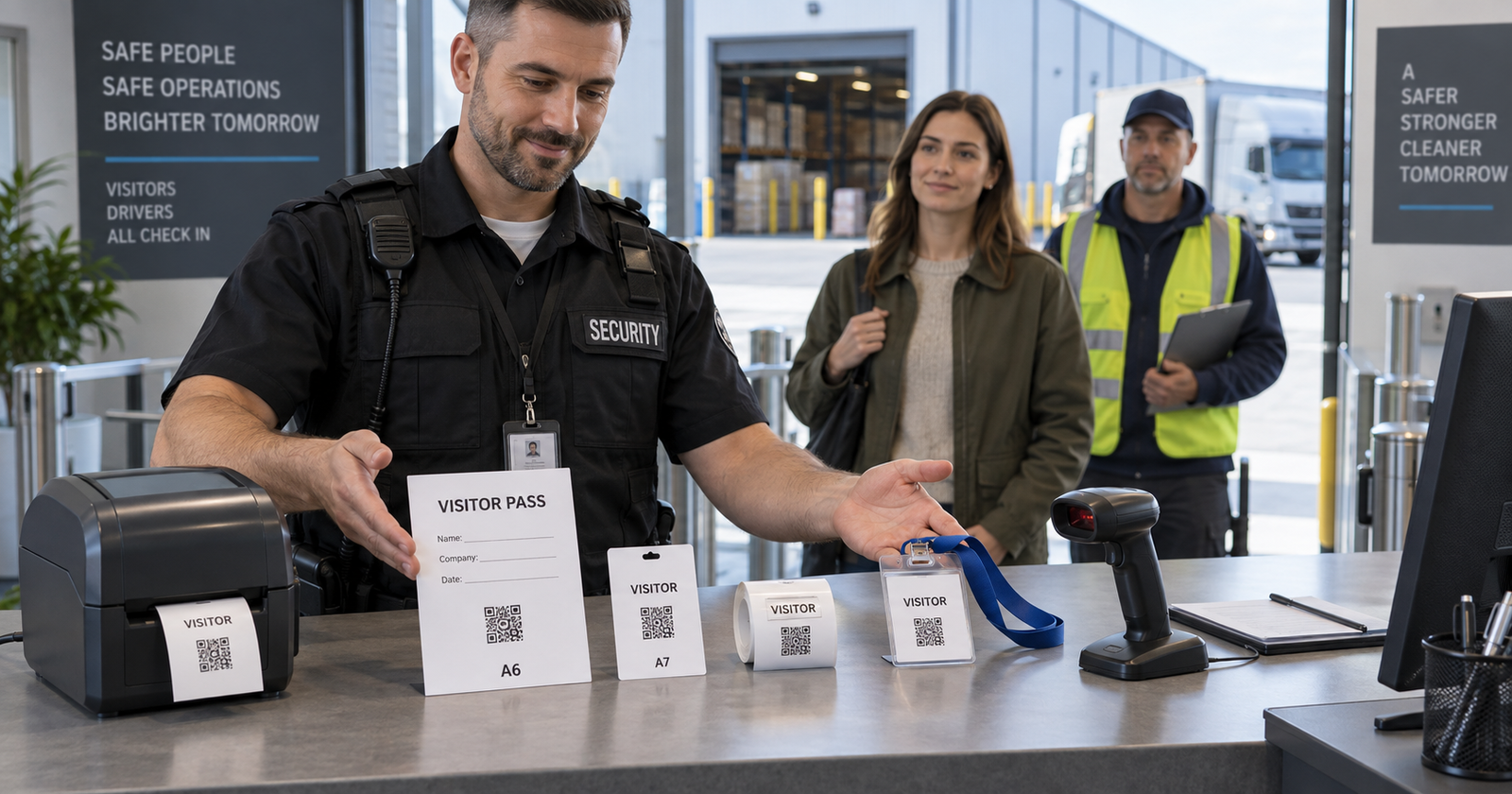
# Gate pass formats: A6, A7, thermal label or badge — what to print and why
Walk into ten different Indian offices, factories and warehouses and you'll find ten different gate passes — a half-torn A6 slip at one, a laminated badge on a lanyard at another, a thermal receipt curling out of a small printer at a third. Nobody sat down and designed this. It evolved from whatever printer was lying around, whatever paper stock the stationery vendor stocked, and whatever the security guard on duty that year decided looked official enough. The result is a patchwork that rarely matches the actual risk at the gate. A6 remains the most common gate pass format for corporate offices because it offers enough surface area for a photo, host name, and timestamp without wasting a full sheet of paper. For visitor management at a corporate reception desk, an A6 gate pass format works well because it leaves room for a signature line alongside the photo and host details.
The format of a gate pass isn't a design choice — it's a functional decision. A visitor walking into a corporate office for a one-hour meeting doesn't need the same pass as a transporter's driver bringing in twenty tonnes of raw material, or a contractor's mason who'll be on the shop floor for six months. Print too little and your guard can't verify anything at a glance. Print too much and you've wasted paper, ink and time during a shift change when fifty people are queued at the gate. Get the format wrong and the pass either gets ignored or gets copied by hand into a register anyway, defeating the point of having one.
This piece walks through the common gate pass formats — A6, A7, thermal label, and badge. It explains which format fits which situation. This includes visitors, vehicles, contractors, or material movement. The piece also factors in field realities of Indian sites. These realities are considered carefully, not glossed over.
Why format is a functional question, not a stationery one
A gate pass has to survive its own journey. It gets folded into a shirt pocket, tucked under a helmet, taped to a windshield, or clipped to a shirt for eight hours in a factory with dust and machine oil in the air. The paper stock, the size, and whether it needs a hole punch or a lanyard clip all follow from where it's going to live during the visit.
There's also a legibility question at the point of verification. A guard checking a pass at the out-gate in low light, often at the end of a long shift, needs to see the photo, the name, the host, and the time at a glance — not squint at eight-point font crammed onto a strip of paper meant for a shopping receipt. And increasingly, that same pass carries a QR code that gets scanned to close the record, which means the print quality has to be good enough for a scanner to read it cleanly, not just good enough for a human eye. Warehouses handling bulk material movement often skip the A6 gate pass format entirely and switch to A7, since drivers only need vehicle number, quantity, and gate-in time on a slip small enough to tape to a windshield. Warehouses handling bulk material movement often favor an A7 gate pass format for vehicle entries, since it fits easily into a driver's logbook or windshield holder without extra bulk.
A6: the standard for staff, visitors and short-duration passes
A6 is roughly postcard size, and it works well for short visits. A visitor attending a meeting can use this format easily. A vendor dropping off a quotation also fits this use case well. Interview candidates and staff needing temporary access can use it too. It suits anyone spending just a few hours on site.
What it should carry
- Visitor photo and name, captured at the gate
- Host name and department
- Time in, with time out left blank until the visitor leaves
- A QR code that closes the record when scanned at the out-gate
- Purpose of visit, kept to a short line rather than a paragraph
A6 is large enough to hold a legible photo and QR code without cramming, and small enough that a guard can hand it to a visitor without hunting for a clipboard. Most reception desks and gate tablets already default to this size because it balances information density against print speed — you don't want a queue building up at 9:45 AM because each pass takes fifteen seconds to print. If you're setting up a gate for the first time, the /gate-pass-management-software page has a walkthrough of how this ties into the approval and printing flow end to end.
A7: fast-turnaround passes for high-footfall gates
A7 is half the size of A6, and it exists for exactly one reason: speed at volume. Warehouses with constant transporter traffic, campuses with multiple gates running shift changes, or factories where a hundred contract workers walk through in a twenty-minute window before the first shift starts all benefit from a smaller, quicker print.
Where A7 earns its place
- Transporter drivers making a delivery and leaving within the hour
- Short-stay technicians or service engineers
- Repeat visitors already known to security, where the pass is more a formality than a first-time verification
- Any gate where the printer itself is a bottleneck during peak hours
The trade-off is legibility — smaller text and a smaller photo mean the guard needs to be closer to read it properly. A7 works well when it's paired with a QR scan for the actual verification, so the printed text is a backup rather than the primary check. For sites juggling multiple entry points, the /features page lists which formats are configured per gate, since it's common to run A6 at the main reception and A7 at a goods or contractor gate. Choosing the thermal label as your gate pass format makes sense at high-footfall sites where a small receipt printer at the gate can spit out a pass in seconds during a shift-change rush, though the print fades faster than ink on paper. A thermal label gate pass format suits high-turnover sites like exhibition halls or delivery hubs, printing instantly without ink cartridges that can dry out during slow shifts.
Thermal labels: for material and vehicle movement
Thermal labels print without ink onto adhesive or tear-off stock. They suit anything that moves with cargo rather than a person. Examples include a material gate pass stuck to a crate. Another example is a slip handed to a driver alongside a vehicle pass.
Why thermal makes sense here
- No ink cartridge to run dry during a busy dispatch window
- Adhesive stock can be stuck directly onto a box or docket, not just carried in a pocket
- Fast print speed matches the pace of loading bays and dock schedules
- Durable enough to survive being handled alongside physical goods
A material gate pass on a thermal label typically carries the item description, quantity, whether the movement is returnable or not, and the vehicle number — the same fields a store or dispatch register would ask for. For outward movement of material, that pass also needs an approval step, since letting stock leave the premises without sign-off is a different risk than letting people leave. If material movement is a regular feature of your gate — machinery going out for repair, packaging going in from a vendor — it's worth looking at how /features/material-gate-pass handles the returnable versus non-returnable distinction, since the paperwork trail differs for each.
Vehicle passes follow similar logic. A driver's slip and a windshield tag work better on tear-resistant thermal stock. Regular paper disintegrates in the rain during monsoon months. The /vehicle-gate-pass-system page explains how vehicle number, driver details and purpose get tied together. VizPass does not attempt to read number plates automatically. It also does not open barriers on its own. Those actions remain manual steps at the gate. Guards match them against the printed or displayed pass.
Badges: for anyone staying on site for days or weeks
A badge is printed on card stock and clipped or worn on a lanyard. It suits anyone whose presence on site outlasts a single day. This includes a contractor's crew working a multi-week job. It also includes a long-term consultant on-site for weeks or months. Interns doing a rotation across departments fit this format too. Long-duration contractors are better served by a badge-style gate pass format with a lanyard clip, since a paper slip won't survive six months of daily wear on a dusty shop floor. Long-duration contractors working on a shop floor for months are better served by a badge gate pass format, which withstands repeated clipping, dust, and daily wear far longer than paper.
What sets a badge apart
- Designed to be worn continuously, not carried and discarded
- Usually includes a validity window rather than a single time-in and time-out
- For contract labour, the badge should reflect the induction and safety training status, since a badge that's still being worn past its expiry is exactly the gap a safety audit will flag
- More durable stock survives a shift on a factory floor better than a paper slip
Contract labour is where badge format matters most. The risk isn't just "who's on site." It's "is this person authorised to be here today." A contractor's validity or induction expiry gets checked at the gate. This happens before the badge is issued or renewed. Frameworks like the Contract Labour (Regulation and Abolition) Act 1970 apply here. The OSH Code 2020 sets safety expectations too. Keeping a record of who was inducted and when is not optional paperwork. It's the paperwork that gets asked for first in an inspection. Factory sites under the Factories Act 1948 carry similar expectations. The relevant state Factories Rules apply as well. Guidance from bodies like DGFASLI reinforces this point. A badge that clearly shows validity status is worth it. The slightly higher cost of card stock over paper pays off. The /features/contractor-and-labour-entry page explains this in detail. It covers how induction expiry is checked before a badge renews. This renewal happens daily or weekly, depending on the contract.
Matching format to visitor type: a quick reference
Rather than treating format as an aesthetic decision, it helps to map it directly to who's walking through the gate:
- A6 badges suit visitors, interview candidates, one-time vendors, and staff temporary passes.
- A7 badges work for high-volume transporter drivers, short-stay technicians, and repeat known visitors.
- Thermal labels handle material movement (inward/outward), vehicle passes, and courier slips.
- Badges are for contract labour, multi-day consultants, long-term interns, and anyone needing a validity window.
Couriers deserve a specific mention here since they don't fit neatly into "visitor" or "material." A courier delivery is usually logged rather than issued a full pass — the item, sender, recipient and time matter more than a photo ID check, so a lighter-weight log entry, printed or not, is usually sufficient. Whichever gate pass format a site picks, the QR code printed on it must remain scannable, which rules out thermal stock that's been folded or exposed to heat near machinery. Choosing the wrong gate pass format for night-shift verification can slow down security checks, since guards need bold, glance-readable fields rather than dense text meant for a smaller slip.
What the format can't fix
No pass format, however well chosen, substitutes for the process behind it. A well-printed badge means nothing if nobody checks whether the induction it references has actually expired. A thermal label on a crate is only useful if someone actually verifies the quantity against what's declared before the vehicle is waved through. And a QR code printed cleanly on any of these formats only closes the loop if it's actually scanned at the out-gate rather than glanced at.
This is also where the paper-versus-digital question resurfaces. It's covered in more detail in Paper Visitor Registers Compliance Risk: What You're Missing. A beautifully formatted pass isn't enough on its own. If it isn't tied to a searchable, exportable record, it's still just paper. The point of choosing the right format is to support a working system. That system should answer, at any moment, who is on site. It should show whose out-time is overdue. It should also flag which material left the gate without matching approval. The goal isn't to produce a nicer-looking slip of paper.
Conclusion
The right gate pass format isn't about looking official — it's about matching the print to the risk and the duration of the visit. A6 for the everyday visitor, A7 where volume demands speed, thermal labels for anything moving with cargo, and badges for anyone whose presence on site stretches across days or weeks. Get this mapping right and your guards spend less time squinting at illegible slips and more time actually checking who's in front of them.
VizPass generates all six pass formats automatically from the same gate tablet workflow. The visitor's photo and ID are captured right at the gate. The host approves the visit on WhatsApp. The right format prints with a QR code attached. That QR code closes the record the moment it's scanned on exit. If your gate still runs on whatever paper stock is in the drawer, it's worth seeing this in practice. Book a walkthrough at /contact to get started. Or start a 7-day trial for ₹4,999/month from the office in Sector 62, Noida. See for yourself which format actually fits your gate.